ступил когда запостил - ссылка пропадёт, а я не скопировал описание.
исправляюсь
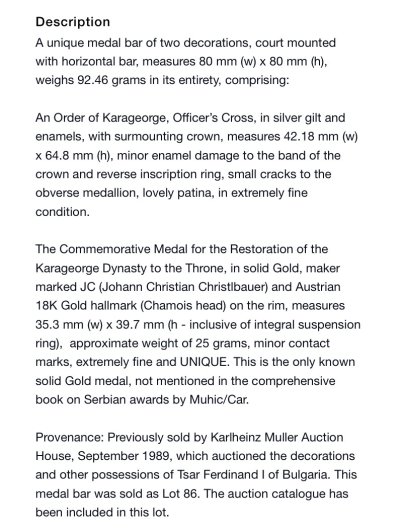
Description
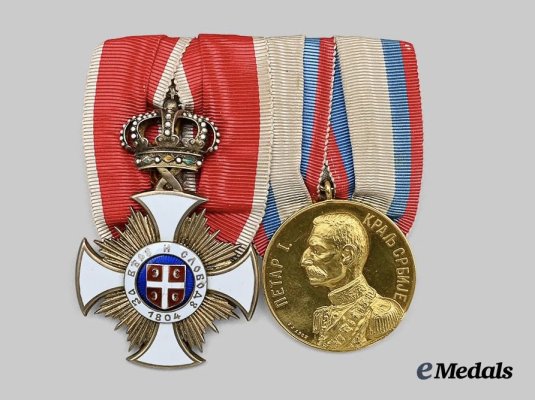
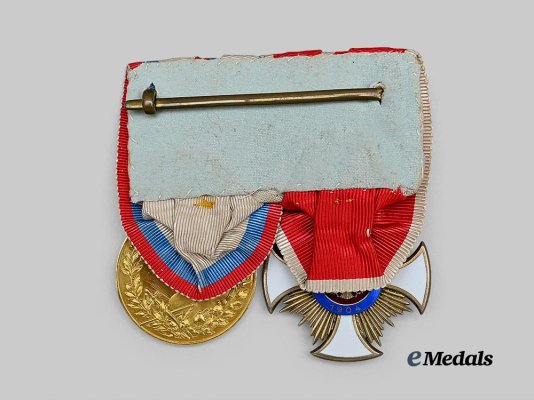
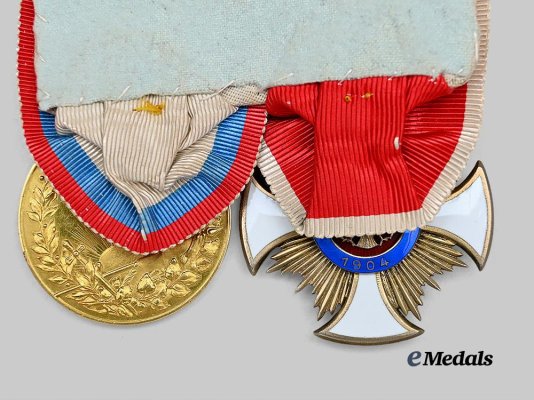
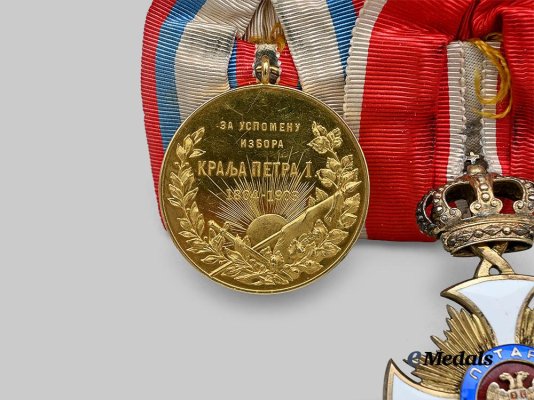
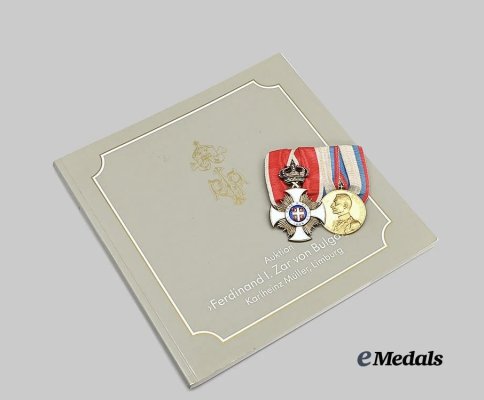
A unique medal bar of two decorations, court mounted with horizontal bar, measures 80 mm (w) x 80 mm (h), weighs 92.46 grams in its entirety, comprising:
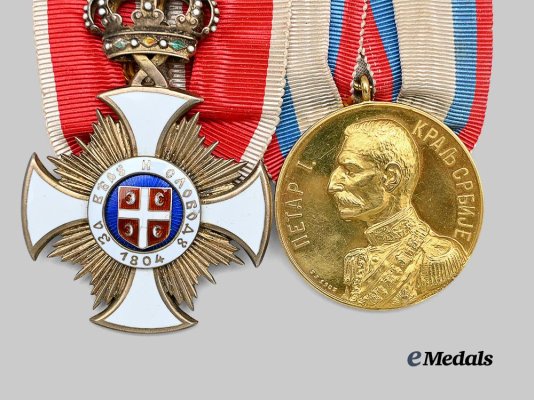
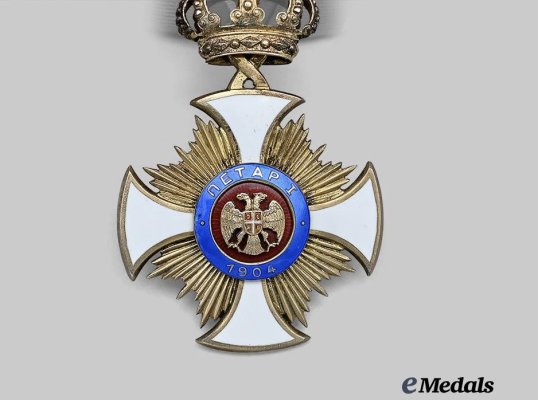
An Order of Karageorge, Officer’s Cross, in silver gilt and enamels, with surmounting crown, measures 42.18 mm (w) x 64.8 mm (h), minor enamel damage to the band of the crown and reverse inscription ring, small cracks to the obverse medallion, lovely patina, in extremely fine condition.
The Commemorative Medal for the Restoration of the Karageorge Dynasty to the Throne, in solid Gold, maker marked JC (Johann Christian Christlbauer) and Austrian 18K Gold hallmark (Chamois head) on the rim, measures 35.3 mm (w) x 39.7 mm (h - inclusive of integral suspension ring), approximate weight of 25 grams, minor contact marks, extremely fine and UNIQUE. This is the only known solid Gold medal, not mentioned in the comprehensive book on Serbian awards by Muhic/Car.
Provenance: Previously sold by Karlheinz Muller Auction House, September 1989, which auctioned the decorations and other possessions of Tsar Ferdinand I of Bulgaria. This medal bar was sold as Lot 86. The auction catalogue has been included in this lot.
Footnote: Tsar Ferdinand I of Bulgaria (1861–1948) ruled as prince from 1887 and later as tsar from 1908, when Bulgaria formally declared independence from the Ottoman Empire. During the Balkan Wars (1912–1913) and the First World War, he aligned Bulgaria with the Central Powers in an effort to expand Bulgarian territory. Following Bulgaria’s defeat in 1918, Ferdinand abdicated in favour of his son, Boris III, and spent the remainder of his life in exile.
Tsar Ferdinand I received an extensive array of orders and decorations from both Bulgaria and foreign states, reflecting his dynastic connections and diplomatic standing in Europe. Domestically, he was Grand Master of the Order of St Alexander, the kingdom’s highest award, as well as the Order of Civil Merit and the Order of Military Merit. From abroad, he was a knight or grand cross of numerous senior chivalric orders, including the Order of the Golden Fleece (Austria-Hungary), the Order of the Black Eagle (Prussia), the Order of St Andrew (Russia), the Order of the Bath (United Kingdom), the Légion d’honneur (France), and the Order of the Annunciation (Italy). These decorations underscored Ferdinand’s position as a European monarch closely tied to the major royal houses of the late 19th and early 20th centuries.



 www.emedals.com
 IMG_7786.jpeg205.2 KB · Просмотры: 12
 IMG_7779.jpeg210.5 KB · Просмотры: 13
 IMG_7780.jpeg117.3 KB · Просмотры: 9
 IMG_7781.jpeg184.1 KB · Просмотры: 7
 IMG_7782.jpeg159.1 KB · Просмотры: 5
 IMG_7783.jpeg139.8 KB · Просмотры: 7
 IMG_7784.jpeg162.6 KB · Просмотры: 10
 IMG_7785.jpeg92 KB · Просмотры: 11